In Defense of... Bo Bichette? (Pt. 2)
And really, who needs defense, anyways?


Welcome back! If you haven't read Part 1 of this analysis yet, I highly recommend doing so before diving into this. Since I covered Bo's offense there, this part of the breakdown focuses on everything else: his defense, his contract, and what questions we're still pondering going into the season. I'll skip most of the preamble this time around, save for reiterating that I'll do my best to make various acronyms and statistics accessible to those of you who don't read about analytics all the time. Let's get cooking, shall we?
The Glove
Bo Bichette is the worst defensive shortstop in baseball.
In theory, anyways. He put up an abysmal -12 DRS and -13 OAA at the position in 2025, accompanied by well-below-average arm strength, so it's close enough to true to get people worked up about how he's going to single-handedly destroy the 2026 Mets by playing a terrible third base. That would be very concerning indeed if it accurately reflected reality, which it fortunately does not.
As with his hitting, we can break down the issues surrounding Bo's defense in simpler terms as well as through the lens of advanced metrics. Before wading into the fire swamp of defensive analytics, let's look at what people actually have to say about the transition from shortstop to third base.
I had a little criticism of one of the WARmonger's tweets in Part 1, but when it came to discussing defense, I found his thoughts on Bo's situation to be very helpful. He thinks Bo will be fine, but why? Well...
It's a simple defensive transition down the spectrum, and an easier position in almost every way (including throwing). Less range needed, fewer responsibilities, just get that reaction time ready!
For the uninitiated, the spectrum in question here is the defensive spectrum, which roughly orders fielding positions in order of difficulty. By extension, it also reflects how hard it is to replace a player at a given position, and so is part of the logic underlying positional adjustments for WAR. Baseball Reference's spectrum, from least to most difficult, is as follows: 1B, LF/RF, 3B, CF, 2B, SS, C. So, generally speaking, third base is easier than shortstop.[1]
Elaborating on the above, the WARmonger cites a couple specific issues with Bo's performance at shortstop that would be less problematic at the hot corner:
I feel like the numbers tell us why he was bad at SS, and those things (range/arm combo) aren't nearly as impactful at the other two spots.
He's struggled with range both sides, covering ground and then making a long throw. Much less of that at 3B. His athleticism should be fine for shorter reaction time, and the extra time to throw might be a huge relief for him.
Even pinning down "range" as a limitation, that doesn't tell us the full story of why Bo struggles with it. There are more or less one zillion factors that go into playing defense, and we really can't measure all of them in a discrete and disjoint way. But surely we can get some of them down correctly, right?
...Right?
Arm strength, at least, should be fairly obvious. We're able to track the velocity of throws made by fielders and use that information to evaluate how much power they're packing. Here's how Statcast puts their metric together:
Given that there is no rulebook definition of "a throw where the player is trying hard," and many non-competitive lobs are captured, we have elected to take the average of the top portion of a player's throws. Since the demands of each position grouping are different, the averages and qualifiers are different as well.
That seems straightforward enough. For 2B/SS/3B, they use the average of the top 5% of throws, with 75 throws needed to qualify. Here are Bo's percentile rankings from each year of his career (note that they only started measuring arm strength in 2020):
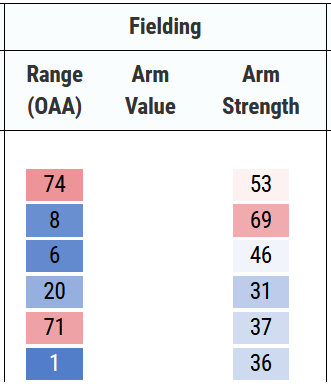
Yikes, both the range and arm strength there are pretty bad! The layperson's instinct is to be concerned about how he can handle throwing from third if he seemingly can't even handle throwing from the typical shortstop region, which we might assume has shorter throwing distances on average than third base does. But there are two big misconceptions underlying this instinct, when the reality is:
- Shortstops frequently have to make longer and more difficult throws than third basemen do. SS involves running around a lot more, obviously, and the increased distance mainly comes from making deep plays on the outfield grass.
- Arm strength is not a central component of infield defense, and therefore doesn't meaningfully reflect fielding skill.
As the WARmonger points out,
Many outstanding infielders don't throw the ball hard because their feet, hands, and timing are so good ... An infielder who is regularly throwing at or near his top velocity probably isn't a very good infielder.
Ke'Bryan Hayes is the best defensive 3B in the game. He led MLB 3B in OAA, DRS, and SABR Index. His arm was 21st percentile among 3B. Max velo under 82 mph and average top throw under 80 mph.
The blue bar shows up on Hayes' Savant page just as we would expect:

The WARmonger goes on to note that quite a lot of skilled infielders have "weak" arms for their positions—including our very own Francisco Lindor. And it's true! For all the years that arm strength has been measured (since 2020), he's never ranked higher than the 37th percentile, and is usually much lower; by contrast, his range has been 98th percentile or above in four of those six seasons, and never below 90th. Bo's arm is, on its own, not a real reason for concern.
I'm often wary of former players' commentary on the game—if you've ever been so unfortunate as to witness Jeff Frye's posting, you'll understand why—but recently retired infielder Kevin Smith chimed in with some neat insights on what he considered the most valuable components of defense. To wit:
- pre pitch timing & first step quickness
- route efficiency/range
- body awareness and proprioception
- positioning and hand presentation
- throwing accuracy
Which makes sense! If you're positioned well and you have a good read on the ball, you don't have to chuck it across the diamond at 95 MPH to get it to first base on time. And you should be able to read the ball well if you want to be a good fielder.
We've seen the growing pains of Bo learning the position in behind-the-scenes videos of fielding drills and a rushed throw or two in spring training games. None of that, to me, calls for panic—players don't adapt to new positions overnight. People raising the alarm prematurely forget that professional baseball players are supremely talented athletes capable of learning new things, even if it takes longer than a day to do so.
The aforementioned zillion factors that make up defense are one reason that defensive metrics are imperfect, and why someone playing one position well doesn't automatically mean they will be able to translate that skill to an "easier" position. There is no one way to field the ball, and a player's shortcomings in one aspect can be made up for by exceptional performance in another. Therefore, using one player's experience switching positions to predict the success of another is an inherently flawed exercise, but we're going to undertake it anyways.
The argument I will lay out is not that everyone who moves from shortstop to third base is going to be amazing at third base. Rather, it's that being a bad shortstop does not mean you will be a bad third baseman. Obviously, one important component in the translation is why you were a bad shortstop to begin with, but The WARmonger's thoughts on Bo's skillset and why it should transfer acceptably have already been addressed. Let's set all that aside for now and look instead at the crunchy advanced stats.
Before bringing up other players, let's look at Bo's defensive stats on their own. I'm leaving the full table in for those of you who know what all these stats are and want to look at them, but for the purposes of this discussion, I'm only looking at the DRS and OAA columns.[2]
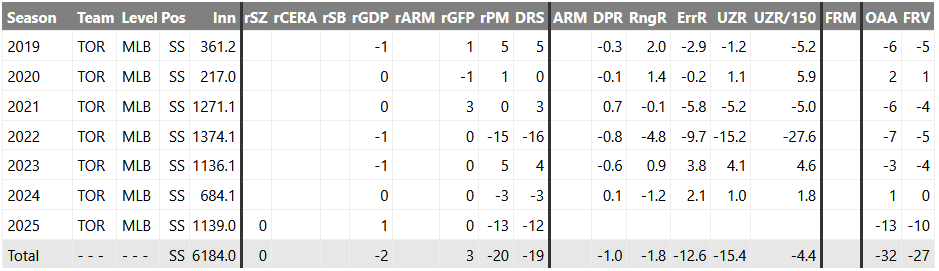
DRS (Defensive Runs Saved) and OAA (Outs Above Average) are somewhat opaque concepts, even to most people who know what the letters stand for. All defensive metrics are messy and complicated, so here's a very brief overview of what these two mean:
- DRS: Given a baseball field, you can roughly divide its territory into "zones of responsibility" for each fielder where they should be making plays. At its most basic level, DRS is calculated based on the probability that a fielder turns a given ball into an out, based on how and where it was hit. The "runs" component essentially tells us the odds of a run scoring in the inning based on the outcome of a particular play (using the run expectancy matrix). These values are added up over time and compared to league average (set at zero) to get a player's DRS.
- OAA: Unlike DRS, OAA gets to use fancy Statcast tracking data in its calculations, though it's still fundamentally based on the probability of a fielder making a particular play. It also keeps things in terms of outs, as the name implies, rather than runs. Like DRS, it's based on a league average of zero.
For a more in-depth (but still comprehensible) explanation of advanced defensive metrics and comparisons between different systems, I recommend checking out this breakdown.[3]
You don't need to be an expert analyst to know that negative is generally bad, and Bo has a lot of negatives in those columns. Not always, mind you—between DRS and OAA, he's had a couple seasons that were at least okay—but more often than we'd like, especially for someone playing a premium defensive position. 2022 and 2025 were especially rough on both fronts, with -16 DRS and -7 OAA in the former season and -12 DRS and -13 OAA in the latter. Put plainly: it's not what you want.
However, these values are relative to other shortstops playing at the same time. On their own, they don't tell us anything about how Bo might perform at third base. To give us some perspective on that, we can instead look at the statistics of other players who have made the same leap.
There are approximately 28 players since 1995 who have, at some point in their careers, spent at least one season of 81+ games at 3B and one such season at SS: Tony Batista, Asdrúbal Cabrera, Starlin Castro, Craig Counsell, Eduardo Escobar, Yunel Escobar, Tony Fernández, Alex Gonzalez, Carlos Guillén, Bill Hall, Gunnar Henderson, José Hernández, Manny Machado, Joey Ortiz, Jhonny Peralta, Hanley Ramírez, Cal Ripken Jr., Álex Rodríguez, Jean Segura, Eugenio Suárez, Miguel Tejada, Juan Uribe, John Valentin, José Valentín, Jonathan Villar, Omar Vizquel, Joey Wendle, and Michael Young. That is, each player had at least one season as primarily a third baseman and at least one as primarily a shortstop.[4]
For those who started out as shortstops, it was usually a late-career and older-age move, because, well, third base is easier. It also often accompanied infrequent playing time and stints at other positions like 2B; rarely did it entail a full-time transition. Some were utility players to begin with. And some players, like Machado and Ortiz, went from third to short instead. Only a handful of players really moved from SS to 3B below the age of 30: Batista, Rodríguez, and Suárez.
To start drawing comparisons between these players and the situation at hand, I'll be looking at three different metrics: FRAA (Fielding Runs Above Average), Rfield (Runs from Fielding), and dWAR (Defensive Wins Above Replacement). Because DRS and OAA aren't always available, these stats make it a little easier to compare across eras by bringing different metrics together in one place, though they're far from perfect. Here's what they're actually made of:
- FRAA: For seasons from 1871–2002, FRAA is based on Total Zone (TZ); from 2002–15, Ultimate Zone Rating (UZR); and from 2016 onwards, OAA. It can be found in the "Fielding" column of the "Value" table on a player's FanGraphs page.
- Rfield: When possible, Rfield uses DRS; when not, it uses TZ, much like FRAA. It can be found in the "Value Batting" table on a player's Baseball Reference page.
- dWAR: Defensive WAR operates much like regular WAR when it comes to the concept of "replacement level", but is based on Rfield and Rpos (Runs from Positional Scarcity), which is a positional adjustment. Adding Rpos to the equation helps give us a better idea of the player's overall defensive value, per our earlier discussion of the defensive spectrum. dWAR is also found in the "Value Batting" table on Baseball Reference.
For all of the following tables, values for the year(s) spent at the "new" position are italicized.
Tony Batista was, by most metrics, a perfectly fine shortstop from 1998–9, and a perfectly fine third baseman from 2000–1 when he moved there for Toronto.
| Stat | 1998 | 1999 | 2000 | 2001 |
|---|---|---|---|---|
| FRAA | 9.0 | 8.0 | 3.0 | 12.0 |
| Rfield | 9.0 | 9.0 | 3.0 | 12.0 |
| dWAR | 1.2 | 1.6 | 0.6 | 1.3 |
A-Rod could be off and on at times, but he was a pretty good defender when he was on. (I've excluded 2001 because, well, he was off.) He put up respectable shortstop numbers in Seattle and Texas before famously moving to third in New York.
| Stat | 2000 | 2002 | 2003 | 2004 |
|---|---|---|---|---|
| FRAA | 16.0 | 12.5 | 11.2 | 9.1 |
| Rfield | 16.0 | 1.0 | 8.0 | 14.0 |
| dWAR | 2.4 | 1.1 | 1.7 | 1.8 |
Geno, of whom I am very fond, was not a great shortstop when he debuted with the Tigers. But his first couple seasons at third in Cincinnati were at the very least serviceable.
| Stat | 2014 | 2015 | 2016 | 2017 |
|---|---|---|---|---|
| FRAA | 0.0 | -10.4 | 3.5 | 3.5 |
| Rfield | -1.0 | -12.0 | -1.0 | 4.0 |
| dWAR | 0.4 | -0.8 | 0.1 | 0.6 |
Just for fun, let's take a look at Manny Machado. After coming up through the minors principally as a shortstop, he had generally been an exceptional third baseman in the majors before shifting back over to his natural position during the 2018 season. Despite his previous experience, the numbers indicate significant struggles in making the transition! (I've only used his numbers with the Orioles in 2018 because he also played some 3B with the Dodgers; they account for 96 of his games played anyways, so it's still the majority of the season.)
| Stat | 2015 | 2016 | 2017 | 2018 (BAL) |
|---|---|---|---|---|
| FRAA | 5.8 | 6.7 | -4.6 | -3.3 |
| Rfield | 15.0 | 21.0 | 12.0 | -10.0 |
| dWAR | 2.1 | 2.8 | 1.6 | -0.4 |
Finally, for comparison, Bo's numbers over the last four seasons:
| Stat | 2022 | 2023 | 2024 | 2025 |
|---|---|---|---|---|
| FRAA | -6.0 | -2.6 | -0.1 | -11.1 |
| Rfield | -16.0 | 4.0 | -3.0 | -12.0 |
| dWAR | -0.8 | 1.2 | 0.2 | -0.4 |
The solid shortstops obviously handled the transition much better. The weaker shortstops, however... still did fine? Bo's 2025 defensive metrics are comparable to Geno's 2015, which was, of course, not good. And yet Geno was completely acceptable at 3B the next two seasons! (Especially when you reintroduce offense into the value equation.) Machado was arguably the best 3B in baseball, and yet by the DRS-based metrics, he looked very similar to Bo and Geno at SS in Baltimore.
My point is not that Bo Bichette will or even can become the best defensive third baseman in the world overnight. The career comparisons here are instead intended to show that shortstops—good and bad—do not inherently suffer from moving to third, and in fact frequently improve; furthermore, going in the reverse direction, you can be a defensive superstar at third and still struggle quite a bit up the middle (even when you aren't brand new to the position). Declaring that Bo is doomed to fail at 3B just because he's been subpar at short is overly hasty and unsupported by the evidence that exists across the league. We simply don't know how he will perform, and it's irrational to assume that it must be terrible. Besides, there's way worse people to learn the position from than David Wright.
The Contract
Much has been made of the lofty expense and confusing structure of Bichette's 3-year, $126MM contract. It's an extreme $42MM AAV (average annual value) and includes opt-outs after the first and second years, which we'll pay him another $5MM each to exercise. The Mets also lose their second and fifth selections in the 2026 Draft, since Bichette rejected his qualifying offer from the Blue Jays. To many people—including me, at first—this sounded like a really bad deal! Then again, most fans aren't experts in contract negotiation.
Upon further reflection, I decided I don't really care if it's a "bad" contract. I'm not actually the one paying for it! It's Steve Cohen's money, not mine. We can talk about the morality of pro sports salaries all day, but the reality is that billionaire owners are spending this kind of money regardless of one individual's contract; this is hardly more egregious than any other component of the capitalist sports complex.
The draft picks are also really a non-issue. It sucks, sure, because we've been pretty good at drafting players and our farm system is strong, but prospects are prospects. Most of them don't pan out. The odds that someone we draft ends up making it to our major league roster and staying there are not what I would call favorable. (And Tarik Skubal was a ninth-round pick, yada yada yada.)
The $5MM buyouts are what baffled me the most about all the initial reporting, because I am not well-versed in the details of player contracts by any means. However, a little searching around helped clear up the mystery of why teams do this. It's far from a unique circumstance—Cody Bellinger just exercised an opt-out for the same payment—but I suspect that 1. many fans don't pay attention to the contract details of players for other teams and 2. people frequently look for any chance to point out the Mets fucking up.
One reason I've seen given for buyouts like this is that they allow some payroll shenanigans in terms of shifting salary across different years; that is, the $5MM hit is to 2027's payroll, not 2026. It's not as simple as just "incentivizing him to opt out". And, while I would generally hate to cite Reddit as any kind of reliable source, this explanation helped clarify why the overall deal made the most sense for the Mets:
They could offer this sort of contract with the opt-outs for $126M/3, or they could offer something comparable to the $200M/7 the Phillies had on the table.
If he's significantly better in Y1 than the full price then he almost certainly opts out, and the Mets got a better player than they paid for on a one year contract. Mets are happy with a one-year bargain and a free roster spot moving forward, Bichette also is happy ... because he has demonstrated that he deserves a higher salary.
If he's worth around $42 + $5M delayed one year in 2026, then the Mets are happy (got what they paid for Y1) whether he opts outs [sic] (now the roster spot is open to sign him again or another player, or to go to youth) or doesn't (they retain an at-market deal for a very good player without a long-term commitment). Bichette's agent considers whether he's better off spending another year with the Mets (because he likes the players/team, because he can show even more to sell the next and better contract, or because he likes betting on himself and getting a second or third year at higher AAV than his next contract that probably sacrifices AAV for length), or using the out and signing a long-term deal for higher security.
If he's worth much less than $42M, it's the worst-case scenario: he stays with the club but the Mets are only on the hook for two more years, as opposed to the six more years they'd have to give him if they wanted him to accept a significantly lower AAV. ... This is still a win for the Mets over the long contract because it's less money and a roster spot freeing up years earlier.
There's more to read in the original comment, but I think that's a big enough wall of text for this post. The overall conclusion is this: it's what we had to do to get him, and it's not as bad as many of us thought it looked on the surface. If he leaves, we have plenty of flexibility to explore other options. If he stays, then we either have an incredible player on the roster for another couple years, or we have someone underperforming for only a couple years instead of, say, seven. We won't know whether that's the case until it happens, so there isn't much point in agonizing over it right now.
The Open Questions
The bat is great. The glove is probably okay. The contract isn't a complete nightmare. So what's left?
- Injuries. They're never what you want, regardless of position, and Bo's had a fair few. In particular, there have been a number of leg injuries, which certainly raise questions about whether they've affected his defense. Backups are necessary everywhere, but this makes me especially grateful to have a strong 3B already on hand in the form of Brett Baty.
- The rest of the roster. Yes, Bo playing third leaves us room to scoot Baty around as a super utility guy and be flexible with a lot of positions, but some of that still depends on everyone handling their new roles adeptly.
- In the event that Bo struggles significantly, do we move him? Where? 1B, and Polanco is displaced to full-time DH (assuming he was playing a solid 1B to begin with)?
- How do we continue to get Baty enough playing time—because he really should be playing every day—while also playing Benge (a fellow lefty) and Polanco? Hopefully he gets to hit more left-handed pitching than he's been allowed in the past.
- If everyone is doing fine, could we potentially look at moving some of our younger players that we don't want to put on the field? More pitching depth is a must-have, and teams like the Red Sox are still harboring a surplus while in need of backup position players. This might be something to watch at the trade deadline.
It's been a long journey, but this finally wraps up my deep dive on Bo Bichette ahead of the season. I'm glad that people seem to have generally come around on him since the signing was announced, and he's one of many developments I'm very much looking forward to watching this year. Thank you for sticking with these essays and giving me more things to think about! It won't be long before you hear from me again—I'll see you on Opening Day.
The spectrum is actually a little controversial and not all that clear-cut. If you're interested in learning more about the issues behind it, I recommend this article from Russell Carleton at Baseball Prospectus and this one from Jeff Zimmerman at FanGraphs as good starting points. ↩︎
I never use UZR on its own. We have other, better metrics. ↩︎
Of course, the metrics discussed here aren't the only ones in existence. This isn't even the only DRS in existence. ↩︎
I really wish I could link you to a Stathead query for this, but I was having a hard time getting what I wanted, so I just looked it up in my own SQL database. That database was dumped directly from Baseball Reference, so this info probably is something you can find on Stathead if you're better at using it than I am. ↩︎